Hey!
I am a postdoctoral researcher at the Max Planck Institute for Astronomy in Heidelberg, Germany. My main research interests lie in the fields of astrobiology and the origins of life.
My research experience ranges from the synthesis of prebiotic molecules on the early Hadean Earth to the parent bodies of carbonaceous meteorites. Currently, I am conducting astrochemical experiments to explore the formation of prebiotic molecules, particularly sugars, in interstellar ice analogs. In the future, I plan to study how temperate super-Earth exoplanets might generate their own prebiotic soups. Studying how high concentrations of prebiotic molecules can be reached through wet-dry cycling on planetary surfaces is crucial to better understanding how non-living matter became life.
I enjoy science communication and was a long-standing Executive Board member of the Origin of Life Early-career Network (OoLEN) . In my free time, I enjoy climbing on via ferratas, weight lifting, scuba diving, and Geocaching.
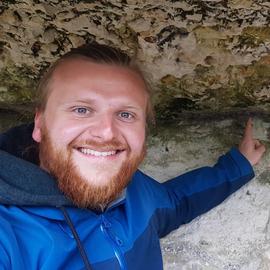
In the picture you can see me pointing on the deposit (black layer) of the dinosaur killer, impacting the Earth around 66 million years ago. As a member of the class of carbonaceous chondrites , this meteorite belonged to the same family of impactors that might have seeded the building blocks of life on our planet in the first place. Therefore, both life and death might arise from meteorites.
- Origins of Life
- Astrobiology
- Prebiotic Chemistry
- Planetary Science
- Computational Physics
- Laboratory Astrochemistry
M.Sc. Physics, 2021
MPI for Astronomy & Heidelberg University
B.Sc. Physics, 2018
Heidelberg University
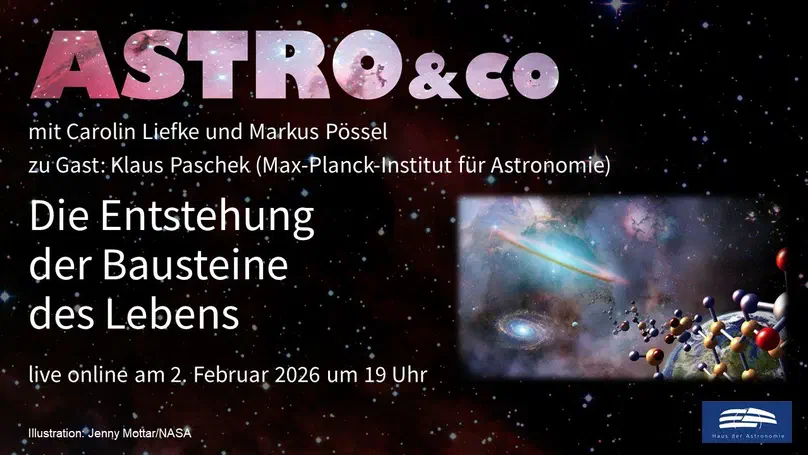
Videos
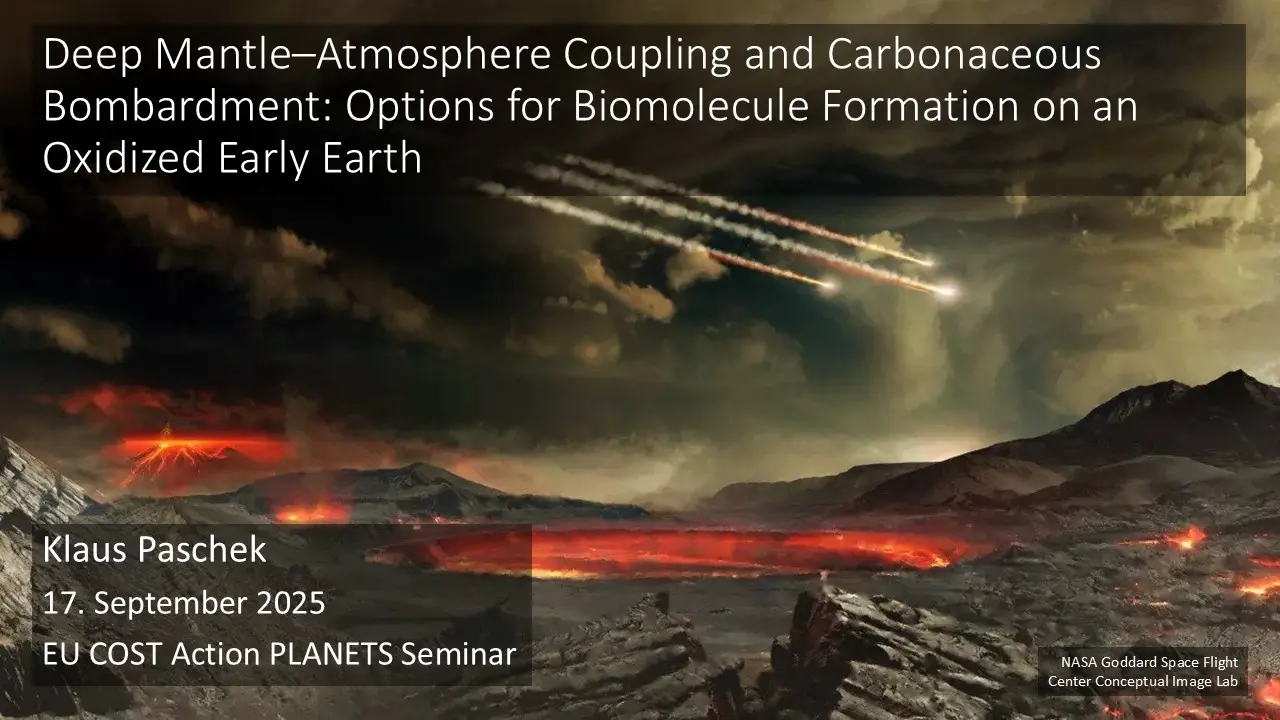
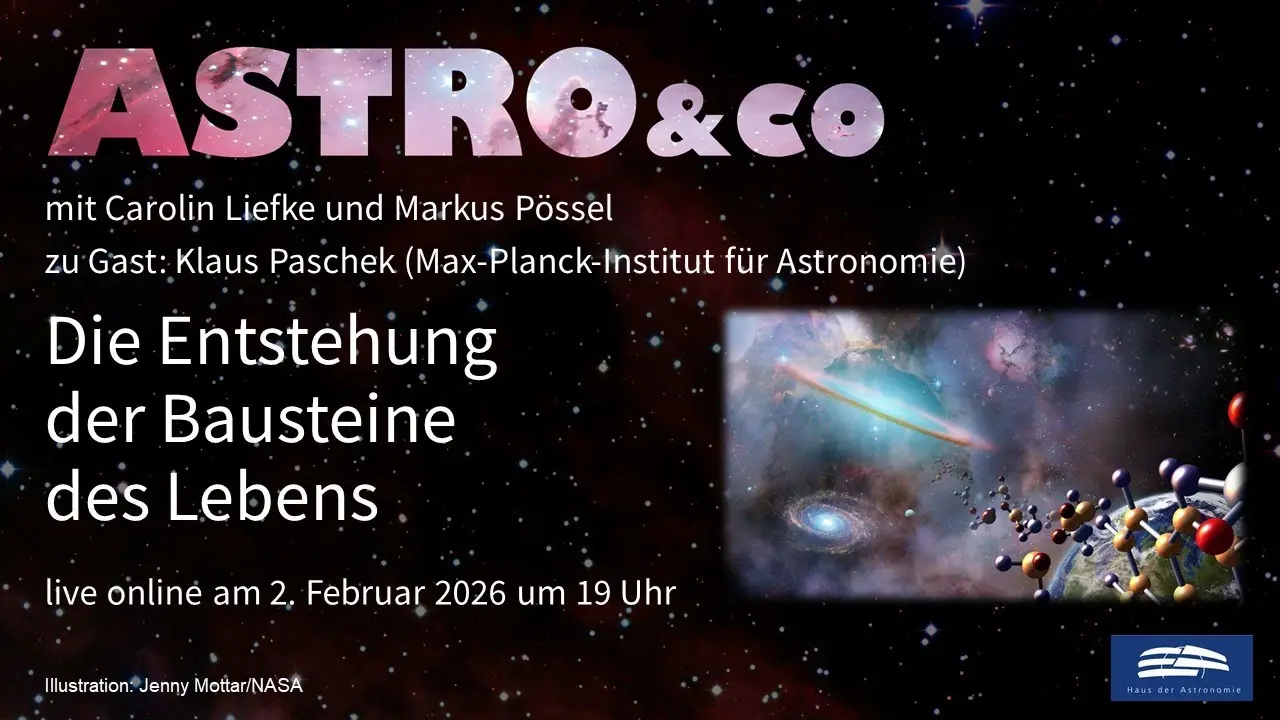
Settings Subtitles/CC German (auto-generated) Settings Subtitles/CC Auto-translate English
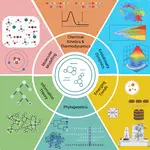
Recent Publications
Curriculum Vitae
Academic Positions
Laboratory project (since Jul. 2025): Catalytic Effects on Sugar Synthesis in Interstellar Ice Analogs, using electron-beam irradiation of ice analogs with subsequent mass-spectrometric analysis
Computational project (since Jul. 2026): Coupling VULCAN and petitRADTRANS: Implications of early Earth geology on HCN and RNA-building block formation, linking interior-driven volatile outgassing to atmospheric photochemistry and observable spectra
Education
Advisors: Thomas K. Henning, Dmitry A. Semenov, Michael Hausmann
Awarded on 10 Jun. 2025
Advisors: Thomas K. Henning, Cornelis P. Dullemond, Dmitry A. Semenov
Related publications: Paschek et al. 2022, Paschek et al. 2023
Including an Erasmus+ semester abroad at Leiden University, Netherlands, from Sep. 2018 – Feb. 2019
Advisors: Michael Hausmann, Hubert Klahr, Georg Lars Hildenbrand
Related publication: Paschek et al. 2021
Honors & Awards
Service
Mentorship
- Mijin Lee, summer internship and Bachelor thesis, 2024 – 2026
Thesis: Synthesis of Prebiotic Vitamin B3 and Lipids in Carbonaceous Planetesimals
(1 paper published, 1 manuscript in revision) - Malin Moll, Master thesis, 2025 – 2026
Thesis: Insights Into Prebiotic Sugar Formation in an Astrochemical Context
Outreach
Presentations
Invited Talks
Contributed Conference Talks
Posters
- Astrochemistry: From Quantum to Cosmos Oct. 2025
- Latsis Symposium 2022: The Origin and Prevalence of Life Aug. – Sep. 2022
- EAI Summer School: Life on Earth and Beyond May – Jun. 2022
Contact
- paschek [AT] mpia [DOT] de
- +49 6221 528-221
-
Königstuhl 17
69117 Heidelberg
Germany - Enter the main building, take the stairs up two floors, turn right, bear right to the elevator, and follow the hallway to Office 319 on your right.